
Wedding cost per guest
The average American wedding costs $292 per guest. That single number is the most useful figure in wedding budgeting, because it turns the guest list — the hardest decision most couples make — into dollars. It comes from The Knot 2026 Real Weddings Study, which surveyed 10,474 couples married in 2025: the average wedding cost $34,200 with 117 guests, and $34,200 divided by 117 is $292. This guide explains what that $292 includes, what it does not, and how to use it to price your own wedding.
What $292 per guest actually means
The $292 figure is the whole wedding-day total spread across the guest list. It is not the price of one plate of food. Catering averages $80 per person — that is the part that is genuinely charged per head. The other $212 is the fixed cost of the day divided by 117 people: the $12,900 venue, the $3,000 photographer, the $4,500 band or $1,800 DJ, the $2,800 in flowers, the $2,000 in rentals, and everything else in the wedding cost breakdown.
That distinction matters. If you add one guest, you do not spend another $292 — you spend about $80 on their food and drink, plus a little for their invitation, their favor, and their share of the cake. But if you add fifty guests, the fixed costs stop being fixed: you need a bigger venue, more tables, more centerpieces, and a bigger dance floor. The $292 average is most accurate when you are comparing whole weddings of different sizes, not when you are adding one name at a time.
It also means the per-guest cost falls as the wedding grows. A small wedding spreads the same $12,900 venue and $3,000 photographer across fewer people, so each guest costs more on paper. A large wedding spreads those fixed costs thinner. The total still goes up with every guest — it just goes up more slowly than $292 a head once the venue and vendors are booked.
Worked examples: 50, 100, and 150 guests
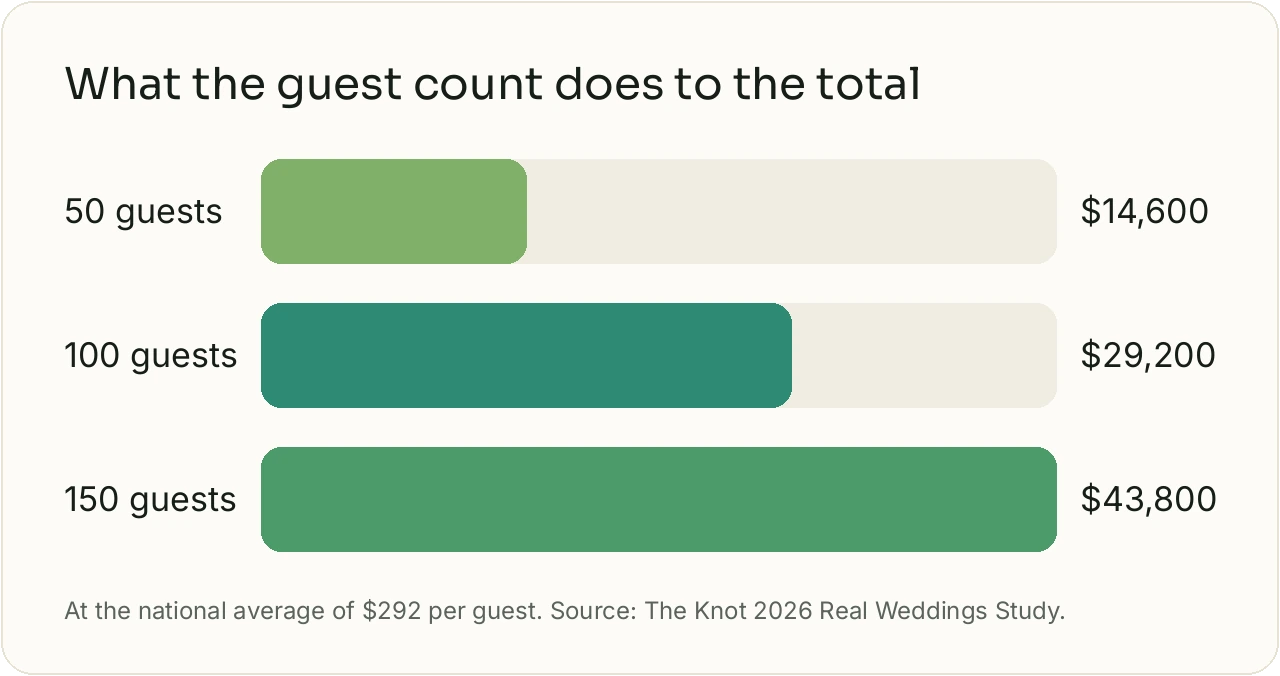
These examples multiply the guest count by the national $292 average. They are estimates from the national average, not quotes — your state, venue, and vendor choices move the real number — but they show how fast the total moves with the list.
50 guests: about $14,600. Fifty guests at $292 each comes to $14,600. In practice, a 50-guest wedding often costs more per guest than this, because the venue, photographer, and music cost nearly the same as for a bigger wedding. But the total is less than half the national average of $34,200, and a small guest list opens up venues — restaurants, gardens, family property — that cannot hold 117 people at all.
100 guests: about $29,200. One hundred guests at $292 each comes to $29,200. That is close to the national median wedding of $24,000, and it is the size most couples picture when they start planning. Catering alone for 100 guests is about $8,000 at the $80-per-person average.
150 guests: about $43,800. One hundred fifty guests at $292 each comes to $43,800 — about $9,600 above the national average. Catering alone is about $12,000. At this size, the venue choice matters more than any other decision: a venue that holds 150 people comfortably is a different price tier from one that holds 100.
The pattern is the point. Going from 50 to 150 guests roughly triples the bill at the national average. No other single decision moves the total that much — not the dress, not the band, not the flowers. If you want a cheaper wedding, the guest list is where the money is. Try your own numbers in the wedding cost calculator, which prices your state and your guest count together.
Why there is no per-guest figure for each state
The Knot publishes a cost per guest only at the national level: $292. It does not publish a per-guest figure for any state. That is a deliberate gap, and we do not fill it with a number presented as fact. Some sites do — they divide the state average by 117 and present the result as though it were surveyed. It was not.
What we can do honestly is estimate. Dividing a state average by the national average guest count of 117 gives a rough per-guest figure for that state, labelled as an estimate. Wyoming averages $17,000, which works out to an estimated $145 per guest. New Jersey averages $57,000, which works out to an estimated $487 per guest. New York averages $49,000, an estimated $419 per guest. California averages $39,000, an estimated $333 per guest. These estimates assume the average guest count is the same in every state, which it is not — guest counts vary by state and by culture — so treat them as a rough comparison, not a price.
The state totals themselves are published figures, and they are the reliable way to compare states. Wyoming at $17,000 and New Jersey at $57,000 are real survey averages; the per-guest numbers derived from them are arithmetic, not data. Our state pages show the published total — see Wyoming, New Jersey, and California — and the methodology page explains exactly which figures are published and which are estimated.
What the per-guest figure leaves out
The $292 covers the ceremony and reception only. It excludes the engagement ring ($4,600 on average) and the honeymoon ($5,500 on average), which are not wedding-day costs, and the rehearsal dinner ($2,800 on average), which is a separate event. If you divide the all-in cost of getting married by your guest count, the number will be higher — but it will also be misleading, because your guests did not eat the honeymoon.
It also averages over very different weddings. A $292-per-guest wedding in Manhattan and a $292-per-guest wedding in rural Idaho buy different things: the Manhattan couple spends most of it on the venue and catering, while the Idaho couple may spend the same per guest with a cheaper venue and a bigger share on photography or music. The national average is a planning tool, not a description of any real wedding.
How to use the per-guest number
Use it three ways. First, to set the guest list: multiply your budget by the inverse — a $20,000 budget at $292 a guest means about 68 guests. Second, to judge a venue quote: if a venue and caterer together work out far above $292 a head for your area, ask what is included before you sign. Third, to compare states: the state average divided by 117 gives a rough sense of how expensive each guest is where you plan to marry, even though it is only an estimate.
And use it with the state figure, not instead of it. The national $292 is the average of a Wyoming wedding at an estimated $145 a guest and a New Jersey wedding at an estimated $487 a guest. Your state page is the number that applies to you. Start there, then use the per-guest math to size the list. The wedding budgeting guide puts the two together in order.
Frequently asked questions
How much does a wedding cost per guest? The national average is $292 per guest, from The Knot 2026 Real Weddings Study: a $34,200 average wedding divided by 117 guests.
How much does a 100-person wedding cost? About $29,200 at the national average of $292 per guest. That is an estimate from the national average; your state and venue move the real total.
Is there a published cost per guest for each state? No. The Knot publishes cost per guest only nationally. Dividing a state average by 117 gives an estimate — Wyoming an estimated $145, New Jersey an estimated $487 — not a published figure.
What is included in the cost per guest? Everything in the wedding-day total, divided by guests: venue, catering, photography, music, flowers, and the rest. Only catering is charged strictly per person, at $80 on average.
Does cutting guests really save that much? Yes. Every guest costs about $80 in catering alone, plus a share of venue, rentals, flowers, invitations, and cake. Cutting 20 guests saves roughly $5,840 at the national per-guest average.
Sources
- The Knot 2026 Real Weddings Study — 10,474 couples married in 2025. National average $34,200, median $24,000, $292 per guest, 117 guests, catering $80 per person. theknot.com/content/average-wedding-cost
- Per-state per-guest figures in this guide are estimates calculated by DimeVow as the state average divided by 117 guests, and are labelled as estimates. No per-state per-guest figure is published by The Knot.
Last checked: November 29, 2026. Figures cover the ceremony and reception only, excluding the engagement ring and honeymoon. See the methodology page for the source and how state figures are shown.