Wedding cost breakdown
The average wedding costs $34,200 — but that number tells you nothing about where the money goes. Two costs dominate everything else: the venue and the food. Together they take more than half of the average budget, before a single photograph is taken or a single flower is bought. After that, the money spreads across about twenty smaller categories, from the band to the cake. This guide works through all of them, biggest first, using the category averages from The Knot 2026 Real Weddings Study of 10,474 couples married in 2025.
The two costs that decide the budget
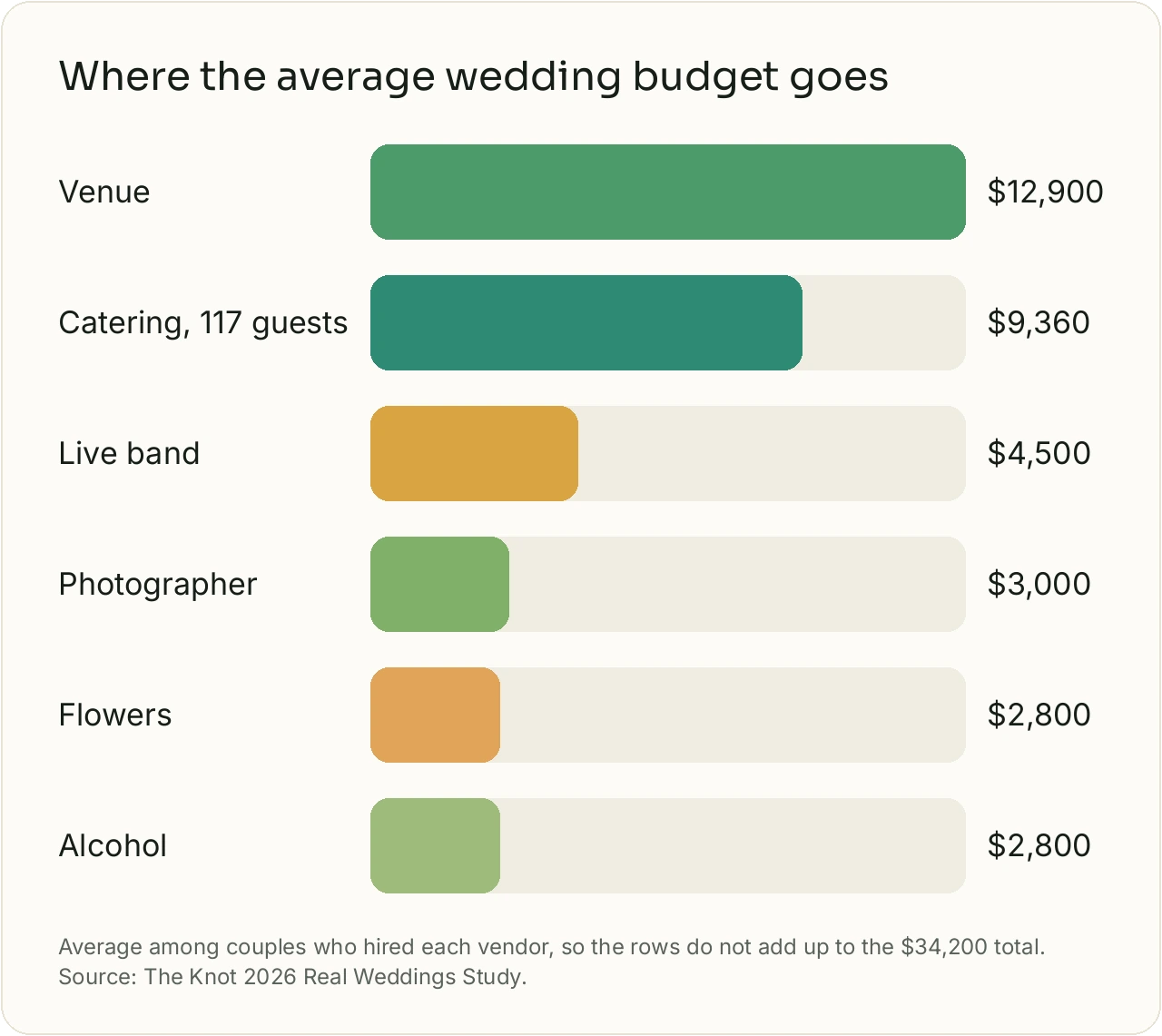
Venue (ceremony and reception): $12,900. The venue is the biggest wedding expense by a wide margin — about 38% of the average total on its own. It is also the least flexible: the venue sets the guest capacity, the date, and often the caterer, since many venues require you to use their in-house catering or a short approved list. Pick the venue first and the rest of the budget follows from it.
Catering: $80 per person. Food is the second biggest cost, and the only one that scales directly with every guest you invite. For the average wedding of 117 guests, $80 a head works out to about $9,360. Add alcohol — $2,800 on average — and food and drink together come to roughly $12,160, nearly as much as the venue itself. This is why the guest list is the budget: every name you add costs about $80 in food before anything else.
Venue plus catering is roughly $22,260 for the average wedding — about two-thirds of the $34,200 total. Every other category fights over the remaining third. If you want the fastest sense of what your wedding will cost, price the venue and the catering in your state first. Our state pages give the local total — for example, California averages $39,000 while Ohio averages $28,000 — and the wedding cost calculator turns your guest count into an estimate.
Music, photos, and film
Live band: $4,500. A band is the third biggest single cost and the most expensive entertainment choice. A band is typically four or more musicians, and you are paying for every one of them for the whole evening.
Photographer: $3,000. Photography is one of the few costs couples rarely regret, because the photos are what lasts. The average covers a professional photographer for the day; albums and extra hours cost more.
Videographer: $2,300. Film is a separate hire from photography, and not every couple books one. Those who do pay $2,300 on average.
DJ: $1,800. A DJ costs less than half of a live band, which is why switching from a band to a DJ is one of the biggest single savings available — about $2,700 on average. Some couples book both, but most pick one.
Non-musical entertainment: $1,500. Photo booths, live painters, fireworks, and other extras average $1,500 among the couples who book them. This is the easiest category to cut entirely: nothing here is required for a wedding to happen.
Flowers, decor, and the look of the day
Flowers: $2,800. Bouquets, boutonnieres, ceremony arrangements, and table centerpieces average $2,800. Like catering, flowers scale with guest count: more tables mean more centerpieces.
Event rentals: $2,000. Tables, chairs, linens, tableware, and tents for venues that do not include them average $2,000. Some venues bundle rentals into the venue fee; others leave you to hire everything separately, so check what your venue price actually includes before comparing it with another.
Lighting and decor: $1,900. Uplighting, draping, signage, and other decor average $1,900. This is another category that grows with the size of the room: a bigger venue needs more of everything to fill it.
Attire, rings, and the people
Wedding rings: $3,000. The couple's wedding bands average $3,000 combined. This is separate from the engagement ring, which averages $4,600 and is excluded from the wedding-day total because it is usually bought much earlier.
Wedding dress: $2,100. The average dress costs $2,100, before alterations. Dress prices vary more than almost any other category, from a few hundred dollars off the rack to five figures for a designer gown.
Wedding or event planner: $2,100. A planner averages $2,100. Full planning costs more than day-of coordination, and not every couple hires one — but those who do pay about the same as a dress.
Additional jewelry: $390. Earrings, necklaces, and other jewelry beyond the rings average $390.
Hairstylist: $150. Makeup artist: $150. Each averages $150 for one person — the bride, in most cases. Bridal party hair and makeup are usually extra.
The smaller items that add up
Transportation: $1,100. Getting the couple — and sometimes the wedding party — between the ceremony, photos, and reception averages $1,100.
Wedding cake: $540. The cake averages $540. It is one of the smallest line items, and one of the most visible.
Invitations and stationery: $510. Invitations, save-the-dates, programs, and place cards average $510. Digital invitations cost far less, but most couples still send paper.
Favors: $480. Guest favors average $480 — about $4 per guest at the average headcount. Like non-musical entertainment, favors are easy to skip without anyone noticing.
Officiant: $260. The person who marries you averages $260 — the smallest professional fee in the whole breakdown.
What is not in the total
Three big costs sit outside the $34,200 wedding-day average. The engagement ring averages $4,600. The honeymoon averages $5,500. The rehearsal dinner averages $2,800. Together they add $12,900 — the same as the venue — but they are bought at different times and often by different people, so the study keeps them separate. If you are adding up everything getting married will cost from start to finish, include them. If you are budgeting the wedding day itself, leave them out.
One warning about the math
If you add up every category above, you get more than $34,200. That is expected, not an error. Each category average is calculated among the couples who paid for that item, and not every couple pays for every item. A couple with a DJ does not also hire a live band. A couple who skips the videographer spends $0 there, not $2,300. The category figures tell you what each item typically costs when you buy it — not a shopping list that sums to the total. Use them to price the items you actually plan to book, and use the wedding budgeting guide to put your own list together.
State matters here too. The national category averages are the same everywhere, but the totals are not: a wedding in New York averages $49,000 while one in Idaho averages $18,000, and the venue and catering in each state move with the local market. See the methodology page for how the figures are sourced and what they cover.
Frequently asked questions
What is the biggest wedding expense? The venue, at $12,900 on average for the ceremony and reception — more than a third of the $34,200 average wedding total.
How much does wedding catering cost? Catering averages $80 per person. For the average wedding of 117 guests, that is about $9,360 — the second-largest cost after the venue.
How much does a wedding photographer cost? The average wedding photographer costs $3,000. A videographer averages $2,300 on top of that.
Do the category costs add up to the average wedding total? No. Each category average is among the couples who paid for that item, and not every couple pays for every item. The figures show what each item typically costs, not a list that sums to $34,200.
How much does a wedding band cost versus a DJ? A live band averages $4,500 and a DJ averages $1,800. Switching from a band to a DJ saves about $2,700 on average.
Sources
- The Knot 2026 Real Weddings Study — 10,474 couples married in 2025. All category averages: venue $12,900, catering $80 per person, live band $4,500, photographer $3,000, wedding rings $3,000, flowers $2,800, alcohol $2,800, videographer $2,300, wedding dress $2,100, planner $2,100, event rentals $2,000, lighting and decor $1,900, DJ $1,800, non-musical entertainment $1,500, transportation $1,100, cake $540, invitations $510, favors $480, additional jewelry $390, officiant $260, hairstylist $150, makeup artist $150. theknot.com/content/average-wedding-cost
Last checked: November 29, 2026. Figures cover the ceremony and reception only, excluding the engagement ring, honeymoon, and rehearsal dinner. See the methodology page for the source and how state figures are shown.